

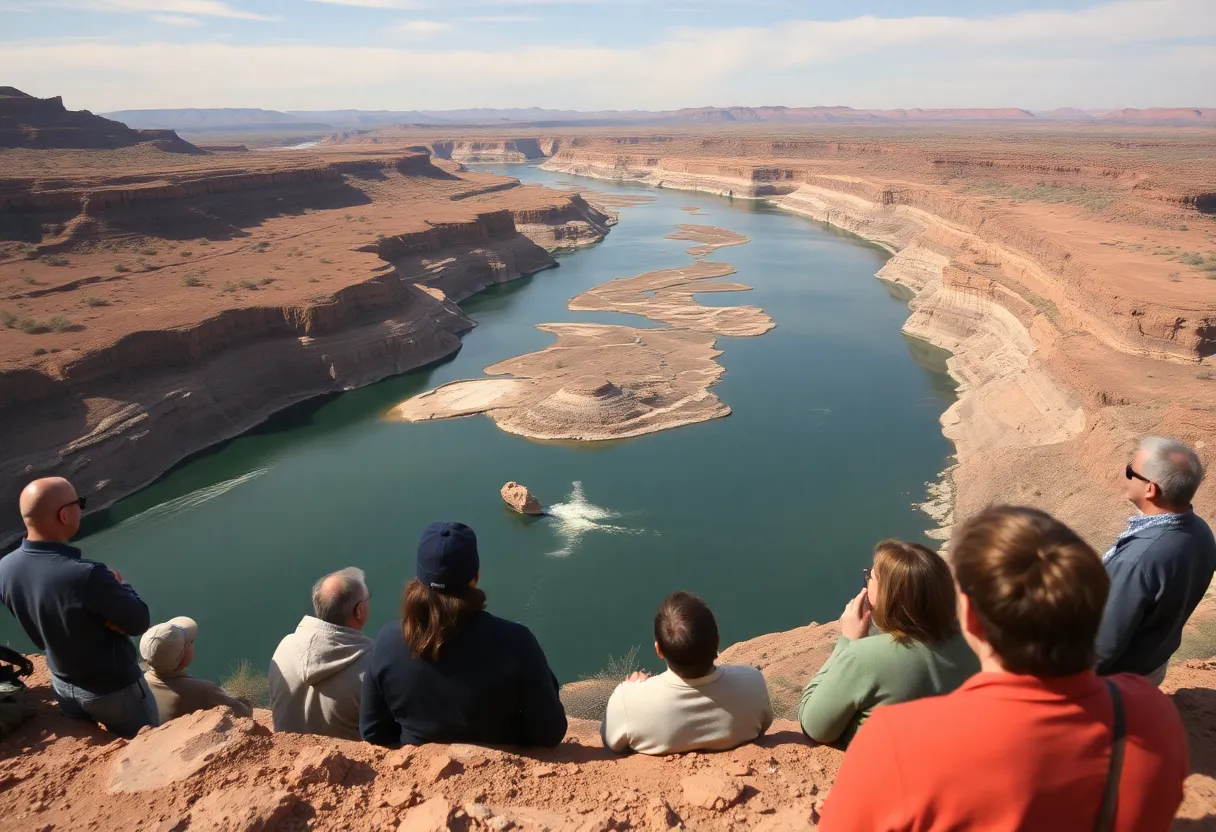
San Diego, California, December 20, 2025
The Colorado River faces an escalating crisis as water levels in major reservoirs like Lake Mead and Lake Powell have fallen below 30% capacity, affecting 40 million people across multiple states. Nobel laureate Elinor Ostrom’s research on community governance presents a unique opportunity for sustainable resource management. Her framework encourages local stakeholders to collaborate in resource management, which could be vital in addressing the pressing challenges of the Colorado River’s water shortages.
San Diego, California
Can Elinor Ostrom’s Insights Help Solve the Colorado River Crisis?
The escalating crisis of the Colorado River, marked by alarming low water levels in monumental reservoirs like Lake Mead and Lake Powell, underscores the urgent need for innovative solutions. With these critical water sources dipping below 30% capacity, the implications for approximately 40 million people spanning seven U.S. states and northern Mexico are profound. An approach grounded in effective local governance, much like those proposed by Nobel laureate Elinor Ostrom, has garnered attention as a promising solution.
Elinor Ostrom’s pioneering work revolutionized how we view collective resource management by illustrating that local communities can effectively govern shared resources without the necessity for privatization or overarching central control. Today, her research serves as a guiding framework for rethinking water management strategies, especially in complex systems like the Colorado River.
Understanding Ostrom’s Framework for Resource Management
Elinor Ostrom, who won the Nobel Prize in Economics in 2009, challenged conventional theories around resource management, particularly the belief that only privatization or government control could avert the pitfalls of overexploitation. Her findings highlighted the potential of communities to devise self-governing institutions capable of managing common-pool resources sustainably.
Applying Ostrom’s Principles to the Colorado River
Central to Ostrom’s approach is the “polycentric” governance model, in which various independent decision-making centers operate under a coordinated framework. This model invites collaboration among local governments, user groups, non-governmental organizations (NGOs), academic institutions, and indigenous communities, alongside federal authorities. For the Colorado River, this inclusive methodology recognizes the diverse interests tied to the river and aims to foster cooperation among all stakeholders.
Historical Precedents of Community-Led Water Management
Ostrom’s early studies, particularly her 1965 doctoral thesis, explored water management efforts in California, where communities confronted aquifer overexploitation. She observed how local groups organized cooperative self-governance structures. These “public entrepreneurs” took proactive measures by creating associations, sharing research, funding joint initiatives, and negotiating collaborative agreements that ensured sustainable resource management.
Implications for the Future of the Colorado River
Implementing Ostrom’s framework in the context of the Colorado River could lead to a paradigm shift in water management strategy. By cultivating dialogue and cooperation among a wide array of stakeholders, the model promises a path toward more sustainable water use and equitable distribution of this vital resource. This innovative shift moves away from traditional top-down management styles, opening doors to more adaptive and responsive governance.
Conclusion
The current Colorado River crisis beckons a re-evaluation of our water management strategies. Drawing on the insights of Elinor Ostrom presents an opportunity to cultivate sustainable and cooperative resource management practices that can alleviate the challenges faced by the millions who depend on the river. It calls for a proactive approach emphasizing community involvement, entrepreneurial innovation, and respect for diverse interests. By supporting local solutions and encouraging stakeholder engagement, we can contribute positively to the economic future of the San Diego region and beyond.
Frequently Asked Questions (FAQ)
What is the current state of the Colorado River crisis?
The Colorado River crisis has escalated, with water levels in major reservoirs like Lake Mead and Lake Powell dropping below 30% capacity. This situation threatens water supplies for approximately 40 million people across seven U.S. states and northern Mexico.
Who is Elinor Ostrom, and how does her work relate to the Colorado River crisis?
Elinor Ostrom, awarded the Nobel Prize in Economics in 2009, challenged traditional views on managing shared resources. Her research demonstrated that communities can develop effective, self-governed institutions to manage common-pool resources sustainably, offering a potential solution to the Colorado River crisis.
What is the “polycentric” governance model proposed by Ostrom?
Ostrom’s “polycentric” governance model involves multiple decision-making centers operating independently but within a coordinated framework. For the Colorado River, this would mean engaging local governments, user groups, non-governmental organizations, academic institutions, and indigenous communities alongside federal authorities.
Can you provide an example of community-led water management from Ostrom’s studies?
Ostrom’s early studies, including her 1965 doctoral thesis, examined water management in California. She documented how communities around Los Angeles, facing aquifer overexploitation, developed cooperative self-governance mechanisms, creating associations, sharing information, funding joint scientific studies, negotiating agreements, and designing monitoring systems to ensure sustainable resource management.
How could Ostrom’s framework be applied to the Colorado River?
Implementing Ostrom’s framework could transform the management of the Colorado River by fostering cooperation among diverse stakeholders, leading to more sustainable water use and equitable distribution. This approach offers a promising path forward, moving beyond traditional, top-down management strategies to a more inclusive and adaptive model.
Key Features of the Colorado River Crisis and Proposed Solutions
| Feature | Description |
|---|---|
| Current Water Levels | Major reservoirs like Lake Mead and Lake Powell are below 30% capacity, threatening water supplies for 40 million people across seven U.S. states and northern Mexico. |
| Ostrom’s Contribution | Elinor Ostrom’s research offers a framework for communities to self-govern and manage shared resources sustainably, challenging traditional privatization or centralized control models. |
| Polycentric Governance Model | A governance approach involving multiple, coordinated decision-making centers, including local governments, user groups, NGOs, academic institutions, and indigenous communities, alongside federal authorities. |
| Historical Precedent | Ostrom’s 1965 study documented California communities developing cooperative self-governance mechanisms to manage water resources sustainably amid aquifer overexploitation. |
| Application to Colorado River | Applying Ostrom’s framework could lead to more sustainable water use and equitable distribution by fostering cooperation among diverse stakeholders, moving beyond traditional top-down management strategies. |
Deeper Dive: News & Info About This Topic
HERE Resources
Mexico Increases Water Deliveries to the U.S. Amid Drought
California Water Leaders Gather for ACWA Fall Conference
San Diego Water Rate Increases Spark Public Outcry

